MoniThon: Data Service Case Study

MoniThon: Open Data-centered Civic Monitoring to Foster Democratic Participation
Data and Service Design: Designing Data-centric Services
Master of Product Service System Design
School of Design (A.Y. 2024/2025) Prof. Francesco Leoni, Andrea Benedetti
1. General Description
Monithon is an Italian independent project started in 2013 by a group originally from OpenCoesione, an open government initiative, to carry out “civic monitoring” marathon.
“Civic monitoring of public policies is a form of participatory evaluation of publicly-funded projects from the point of view of the final beneficiaries” - www.monithon.eu
The service, based on the open source Ushahidi project, offers methods, tools, and training to carry out civic monitoring Report, through three phases: supervise, evaluate, collaborate.
Every intervention is focused on a specific puclicly-funded projects, that can be selected from the ProjectFinder tool at https://projectfinder.monithon.eu/ , where all available open data is provided mainly from OpenCoesione. Citizens that might be affected by a project or are interested in it, carry out their own investigation by collecting data from interviews, visits and such. The assessment of the project is documented by the Report and meant to be shared with policy makers and to complement administrative institutional monitoring, in order to collaborate and co-create value. The Reports, all standard format, are collected and available for consult in the form of a map at https://reports.monithon.eu/ .
Monithon’s intended beneficiaries are not just the citizens who are empowered to evaluate the work of the public administration, but the policy makers as well. The data collected and the enabled collaboration provide invaluable insights. Monithon collaborates with universities as well to contribute in the research and academia involvement in public policies and open data ecosystems. Over the years Monithon has grown beyond Italy to monitor publicly-funded projects all over Europe.
2. Images
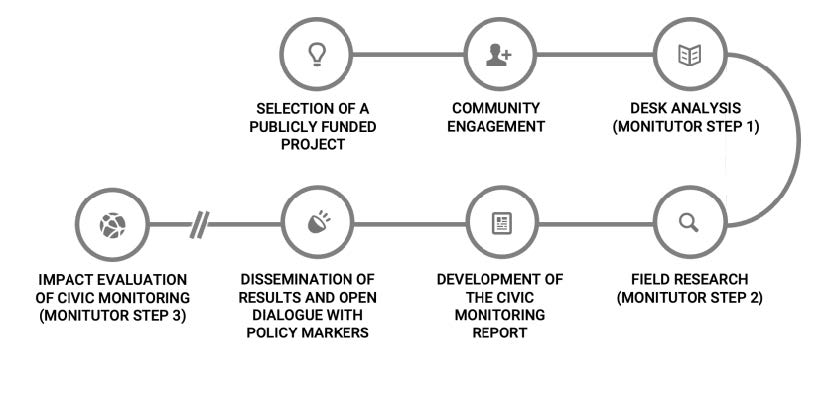 Img. 1: Monithon's phases of civic monitoring of public projects
Src: Monithon. (2022). Monithon methodology: Guidelines for civic monitoring of public funding (Version 1.1).
https://www.monithon.eu/wp-content/uploads/2022/02/Metodologia-EN-ver1.1.pdf
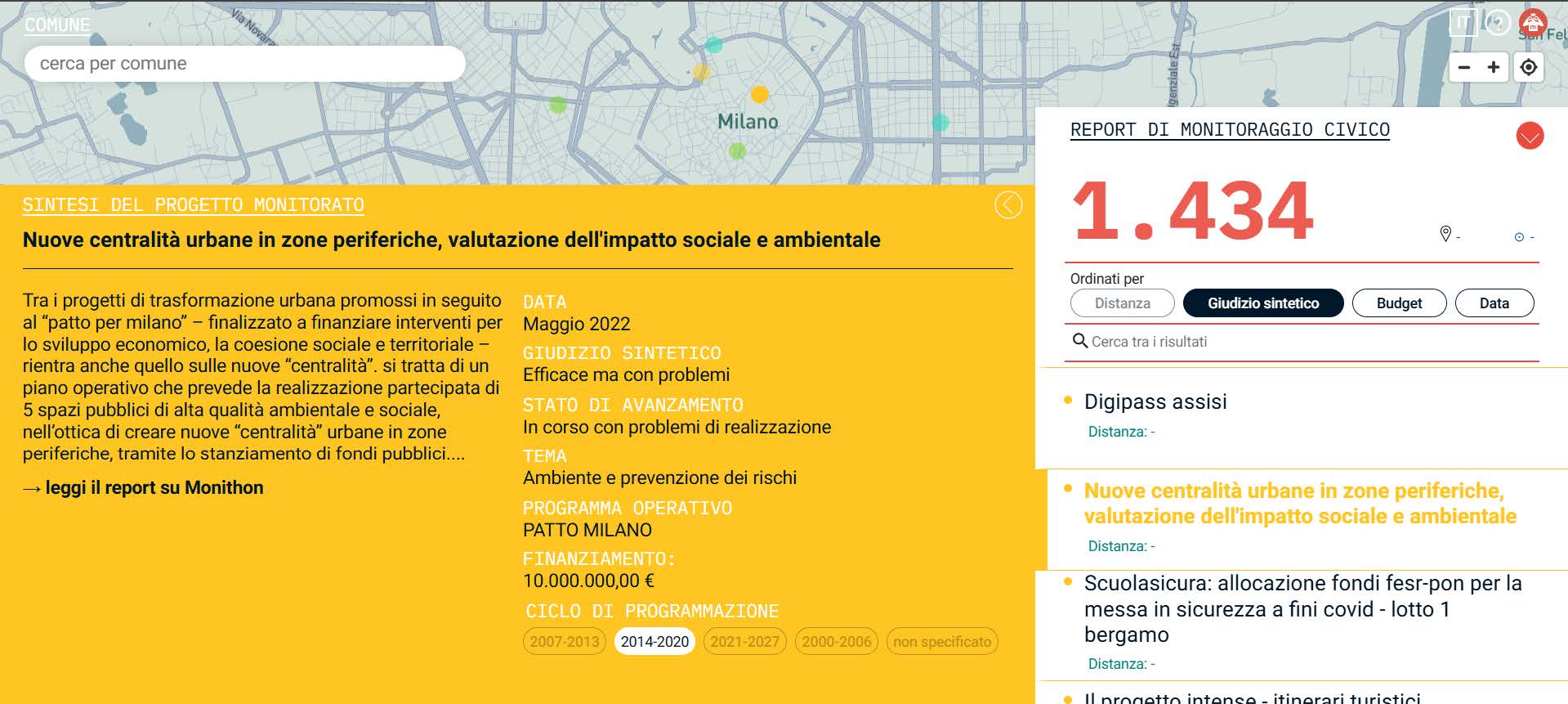 Img. 2: Monithon’s Civic Monitoring Reports Map
Src: https://reports.monithon.eu/
3. Analysis
Monithon was born from the Open Data enthusiasm of the early 2000s, but is the result of a complex clashing of different elements.
In 2011, before the existence of dati.gov.it, a group of italian citizens started collecting all the national public data they could find in one single digital space. The platform spaghettiopendata.org (SOD) was born.
Meanwhile The Open Government Partnership was taking its first steps. Italy joined the partnership right at the start in 2011, assigning the Department for Public Administration (DFP) the role of enacting the principles of OGP at the national level, through biennial National Action Plans (NAP).
Within this framework, in 2012, The Department for the Cohesion Policy and the South launched, as an open government initiative, OpenCoesione which promotes transparency on the use of national and European structural funds and encourages civic participation.
In January 2013 Spaghetti Open Data organized their first event in Bologna, during which a hackathon took place. A group from OpenCoesione participated and suggested a new type of hackathon: a marathon of “civic monitoring”. Moni-thon was born.
According to Jonathan Gray (Gray, 2014) the early government efforts were mainly focused on exploiting the new resource of data in order to boost the economy, putting private organisations first. OpenCoesione seems to be one of the public sector initiatives that use data for governmental and economic efficiency, particularly by delegating some of the state responsibility to the citizens, of course framing it as transparency and empowerment. On the other hand SOD is part of that movement of techy activists, or civic hackers, that are interested in the potential of open data to help democratic participation, mostly with ground-up free services.
In Monithon we can see the strong value of democratic participation merged with the public sector’s desire for efficiency and delegation. According to the analysis on data activism by Milan and Velden (Milan & Velden, 2016), the innovation it brings is not only in terms of services and solution, but more importantly in creating a new understanding of the value and meaning of public data. Monithon is undoubtedly part of what they call pro-activism, they mobilize citizens to ensure public money is used in the best interest of the community, and demand change, while engaging with datafication and fostering data-literacy. As it typically happens they collaborate with the institutions.
We can evaluate how Monithon engages with democracy while fostering a culture of data-centric Public Sector, by measuring it up with the 3 guidelines by Petter Falk (Falk, 2021).
About “Holistic Data Literacy” Monithon is clearly teaching that data are contextual and situated, that’s why at the core of the project there are local communities that collect data from their own lived experience in order to enrich the institutional “detached” data and better inform decision-makers.
Another pillar of the project is the dialogue and collaboration between citizens and government which translates not only in the efforts of designing a precise methodology to collect data but also the digital environment where the data is collected, focusing on a standard that allows for a collective analysis and subsequent insights on public spending and government initiatives.
Lastly, about data as a democratic artefact, it is clear that the value co-created benefits both the single group of citizens or community interested in a particular public service project, and the national, or European, interest in understanding how to effectively use public funds and design meaningful services.
An additional reflection on the democratic balance between cultivation and growth: Monithon comes from “growth”, from activists and from the ground-up, but is now trying to “cultivate” other citizens. It is this imposed structure that might prevent the service from seeing broader participation. They have recently (03/2024) addressed this problem with an additional simplified Report format for individual citizens not organized in groups. In reality most of the reports, and the most successful outcome of the projects, come from a sister initiative A Scuola di Open Coesione, that brings data-literacy projects to high-schoolers, who then are involved in Monithon initiatives. Only when cultivation leads to growth then there can be true democratic participation.
4. References and sources
● Gray, J. (2014). Towards a Genealogy of Open Data. General Conference of the European Consortium for Political Research in Glasgow. http://dx.doi.org/10.2139/ssrn.2605828
● Milan, S. & Velden, L. (2016). The Alternative Epistemologies of Data Activism. Digital Culture & Society, 2(2), 57-74. https://doi.org/10.14361/dcs-2016-0205
● Monithon. (n.d.). Project Finder. https://projectfinder.monithon.eu/
● Monithon. (n.d.). Civic Monitoring Reports. https://reports.monithon.eu/
● Monithon. (n.d.). About Monithon (English). https://www.monithon.eu/about-english/
● Spaghetti Open Data. (n.d.). Cos’è e chi siamo. https://spaghettiopendata.org/archivio/page/cos-e-chi-siamo.html
● Open Government Italia. (n.d.). OGP Italy. https://open.gov.it/en/open-government/ogp-italy ● Monithon. (n.d.). Annual reports – Blog. https://www.monithon.eu/blog/category/report-annuale/
● Monithon. (2024, March 7). Guida al monitoraggio civico semplificato. https://www.monithon.eu/blog/2024/03/07/guida-al-monitoraggio-civico-semplificato/
AI Declaration:
The tool ChatGPT was used to iterate on the writing with prompts such as “How can I make this text shorter? no more than 250 words. Give me suggestions not the final text” and to correct the sources’ format. In this paper there is no original content generated by AI.